CYCLING UP ALTO DE LAS PALMAS: HOW NOT TO TAKE ON MEDELLÍN’S ICONIC CLIMB
What I learnt from riding up Medellín’s famous 15.6 km climb Alto de Las Palmas.
29th Sep 2026 | 13-min read
Alto de Las Palmas introduction: Why does everyone want to climb Palmas?
The heart of Medellín sits on the Aburrá valley floor. The cycling experience in Medellín centres, unsurprisingly, around climbs, and big ones at that. You can’t go for a day’s ride without having to tackle at least one climb. The valley floor rises more steeply on the city’s eastern and western slopes, and on the former, on the way to the international airport, you will find Alto de Las Palmas.
“Palmas” is mighty enough to have featured in the Tour Colombia and other professional cycling races. Sure, part of its appeal must be the opportunity to ride on the slopes that Nairo Quintana has tasted victory on, but there is also its accessibility. Considering where many expats and nomads live in Medellín, the Alto de Las Palmas climb is conveniently located right on people’s doorstep. From what I can gather, every local cyclist has a best time for climbing Palmas. It’s the local cycling equivalent of having a best 5K or marathon time.
The combination of prestige, accessibility and its fearsome profile is what convinced me to tackle Palmas, having never cycled up anything remotely similar. Then, there’s the fact that I’d regularly travelled along sections of the climb, navigating the city (the stretch between the airport tunnel and San Diego, for example), so my mind would always wander to what it must be like to cycle up the city’s iconic climb.
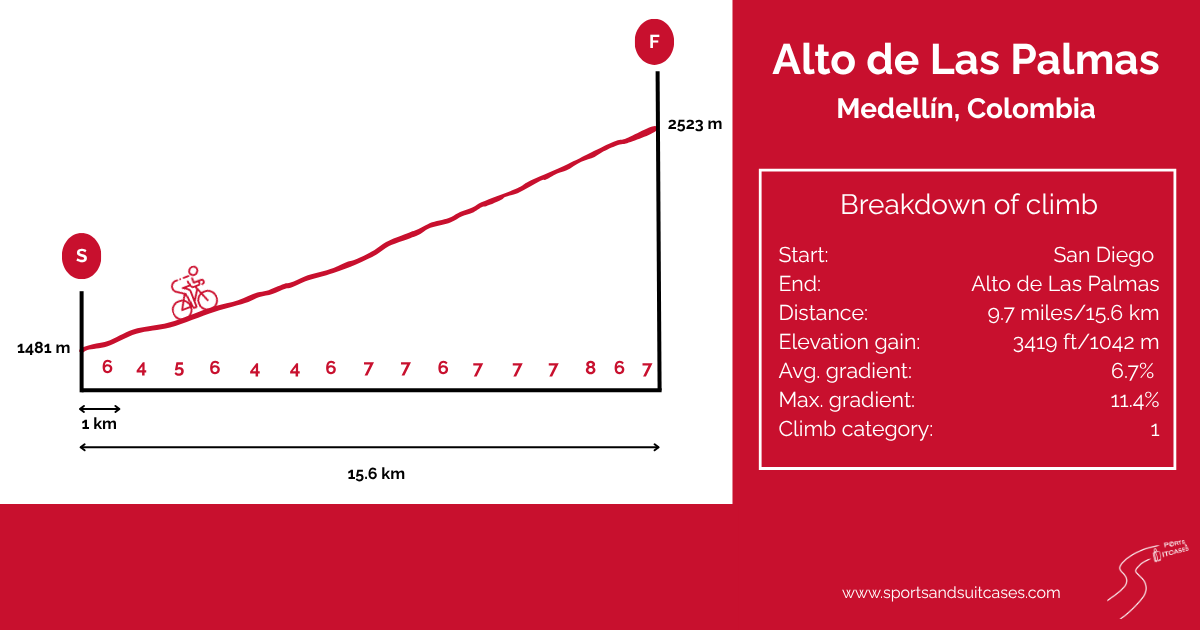
Alto de Las Palmas: Climb profile
Start and end points of the Palmas climb
The route follows Avenida Las Palmas, which begins at the roundabout where Avenida 33 passes under Avenida El Poblado in San Diego, a few hundred yards east of Exposiciones metro station. This is a few miles north of Poblado. The Texaco garage, located just off the aforementioned roundabout, makes a natural meeting point for the climb.
The Viva Las Palmas shopping centre in Altos de las Palmas marks the end of the climb.
Incidentally, Avenida Las Palmas is closed to vehicles between 5:30 and 10:00am on Sundays and public holidays as part of the city’s Ciclovía scheme, where almost 30 miles of major roads become car-free for up to six hours. I chose to take on Palmas on one of these days.
How did I get on cycling Palmas? A breakdown of my ascent and descent
The ascent
As I would soon discover, the Alto de Las Palmas climb deserves more respect than wolfing down my porridge and toast (to avoid being late meeting up with a fellow cyclist), only to begin climbing twenty minutes later. I might get away with that for a casual jog, but not for a climb of this nature. With breakfast still very much swirling around my insides, we began the climb at 7:20am.
A little bit about my cycling background…
I’m more of a casual cyclist who has only ever really ridden by myself. I bought my road bike in 2008, and it’s still the same one I ride today. I’ve never thought about the technical side of cycling. Never used Strava or anything of the sort, so I just rely on ‘feel’ as a metric. Then, I only put clipless pedals on my bike two years ago!
I’m used to rolling terrain and short, sharp climbs that typically last no longer than a mile (Teesdale in County Durham, NE England, by the way - beautiful cycling territory!), although some local climbs out of the dales last closer to three miles. The longest climb I’d ever done anywhere was one in western Sichuan province, China, that took me 45 minutes.
Therefore, the near 10-mile battle up Las Palmas was alien territory to me, a shock to the system, and far removed from any cycling I’ve done before…
Poor fuelling and poor conditioning
To cut a long story short, I suffered all the way to the top! You’ll no doubt be familiar with the lower slopes of the climb from travelling to/from the airport and passing through Poblado. While the lower slopes may not be as steep, the truth is that there’s no rest bite on any of the climb. The elastic between Laura, a Canadian with months’ worth of Antioquian climbing miles in her legs, and me snapped after all of ten minutes. Within four miles into the climb, I’d thrown up… for the first time! Turns out I really should have tested out the local energy gels I bought specifically for the climb! (That’s a rookie mistake - but again, a sign of my slightly casual approach to the climb, as I’d never try new gels for the first time on the day of a race/marathon, for example.) When the second gel was projected back onto the road later on, I knew it was my body rejecting a gel it had never consumed before. That and the breakfast that hadn’t been digested.
For much of the first part of the climb, I also struggled with a tight right quad. I put this down to being on an unfamiliar bike*. Telling myself that each pedal stroke must be damaging the muscle was another mental battle to overcome (fighting with the temptation to use the discomfort as an excuse to jump off the bike). Thankfully, the tightness subsided. I put the tightness down to a lack of conditioning, in that it was the only second time I’d ridden a bike that year. Plus, it was a rental bike (so even if something in the setup is only ever so slightly off, you’ll notice it on terrain like this). Truth be told, I was grateful to throw up and stretch out my quad a few times, as I was more than happy for the chance to get off the bike. Ordinarily, my pride/stubborness wouldn’t have allowed me.
*I hired my road bike from Manila Bike Rental. I’d used them before, and I’d use them again. Cost = 179,000 COP for 24 hours (includes helmet, tool kit and Garmin/Wahoo support). Frame sizes up to 58cm.
Address: Carrera 43B #12-133 in Manila, Poblado
The nature of the Las Palmas climb
The consistent grind of Palmas is what makes it such an unforgiving climb. The only real fleeting (and by fleeting, I mean very fleeting) rest bite is around road infrastructure like junctions or when you pass the tunnel entrance. Aside from that, it’s up, up, up! Don’t be expecting Alpine-style hairpins. The climb is made up of small bends and sweeping bends that reveal the valleyside below, with just one hairpin. Sure, the scenery is spectacular, but that’s not what you’re riding Palmas for. Like me, you may have already been in Medellín a while, so the views, while beautiful, are nothing new. I certainly felt numb to them while cycling up Palmas; too tired and absorbed in my world of hurt to take them in. Bear in mind that your views will be obscured by the roadside treeline for over half the climb. You do have the Mirador de Poblado, almost six miles into the climb, which is an obvious spot to rest and appreciate the views. Another mirador is just up the road from this one.
The number of cyclists who seemingly breezed past me warped my sense of how hard the climb was. They made me feel I was slower than I probably was. It’s also sobering to learn that Palmas isn’t even the hardest climb in the area, and for local cyclists out on a big day’s cycling, the climb is just a prelude to other climbs. However, this climb is tackled by all kinds of cyclists, and a look at the kit and the bikes of the cyclists around you makes you aware that elite cyclists tackle this climb. That is the beauty of climbing Palmas on a Ciclovía day - it has a sportive feel to it. There must be hundreds of cyclists tackling the climb on any given Sunday/Ciclovía day.
As I took on this climb with no cycle computer or Strava, I was grateful that the distances are well signed on the road. When you eventually pass a Texaco garage, the suffering is nearly over, with only a final kilometre, comprising a hairpin and a right turn with trees agonisingly blocking the summit, left to be climbed.
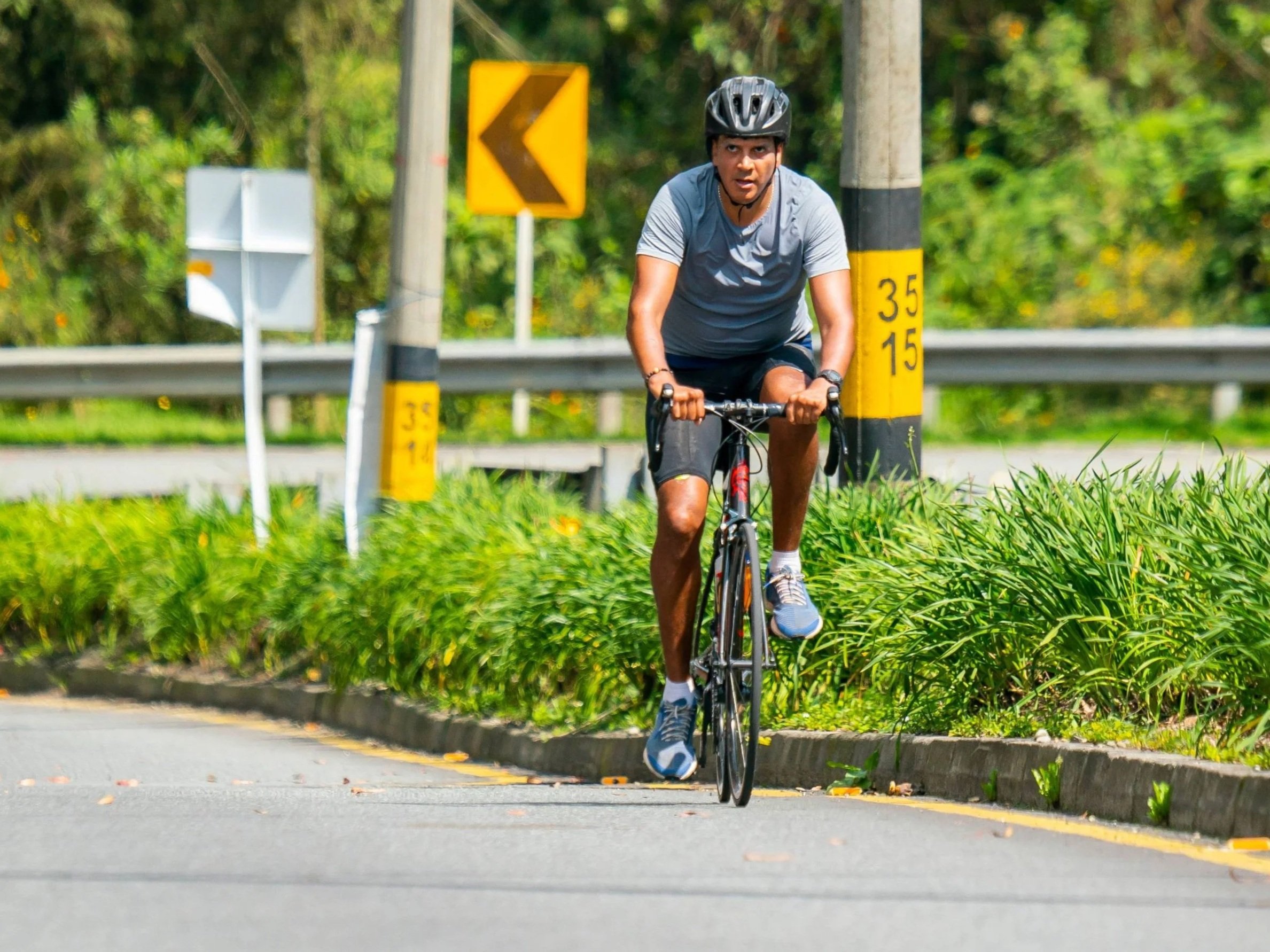
Probably the worst kitted out cyclist on Palmas that day!
Photographers* alongside the road are another indicator that you will soon be put out of your misery, as they position themselves near the top of the climb.
*Several photographers take photos; a local cyclist should know of at least one (these photographers can often be found on Instagram). The action shot of me was taken by Alta Montaña Fotografía. They must have taken over a dozen shots of me. One photo costs 13,500 COP, but without a Colombian bank account or Nequi/Daviplata, you’ll probably have to rely on a Colombian to buy it on your behalf, as I did.
The summit
A whole two hours and twenty minutes after taking my first pedal stroke at the foot of the climb, I rolled over the ‘finish line’. That gave me an average speed of a whopping 4.2 mph/6.7 kmph. I feel like I did well to go as fast as that!
If I’m honest, I figured I’d be around 90 minutes, but really, my calculations were not based on anything concrete. If you haven’t done comparable climbs, it’ll be pretty hard to estimate a time.
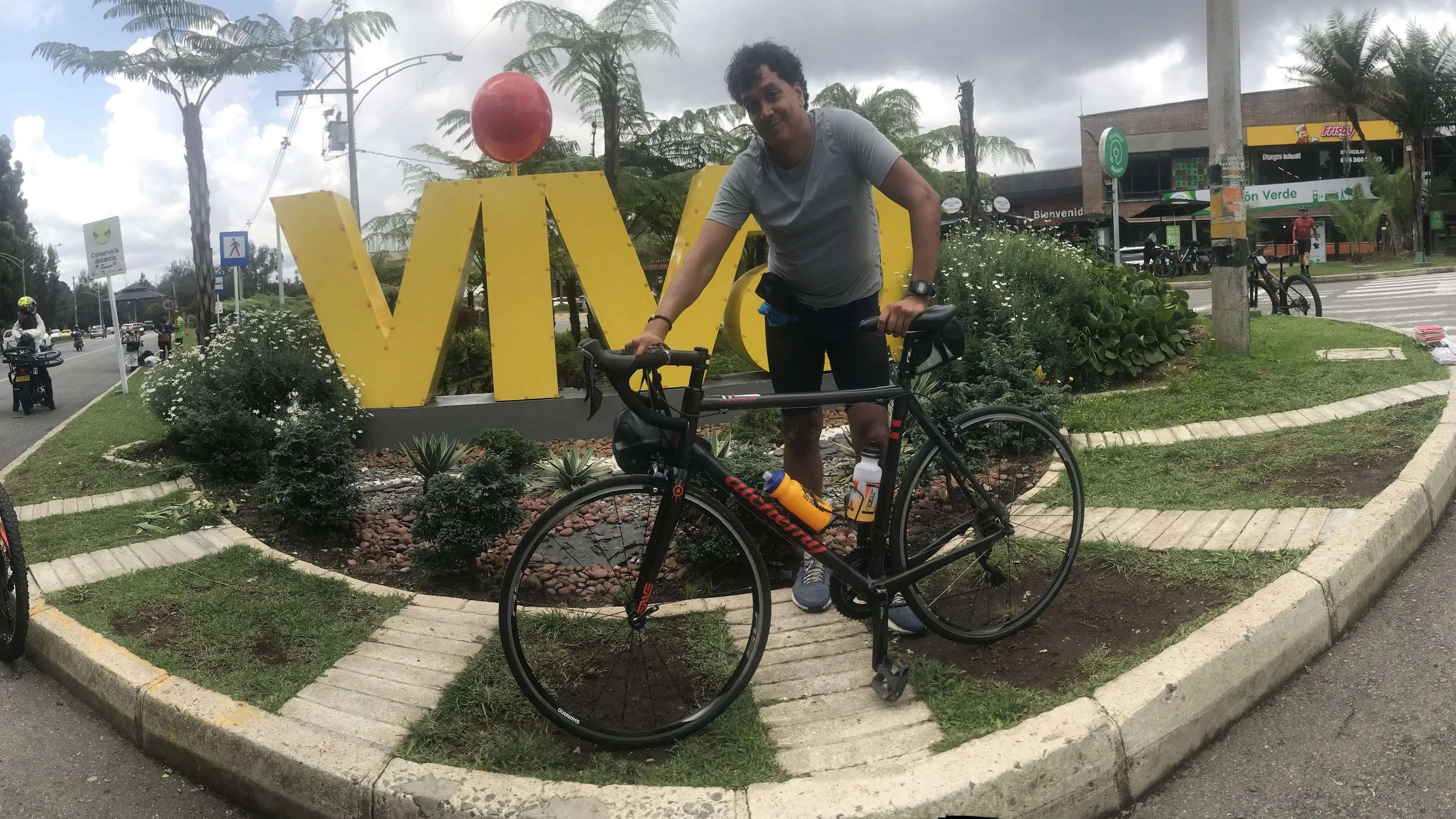
The Viva Las Palmas shopping centre marks the end of Alto de Las Palmas climb
When I listen back to voice messages I sent at the top, the hollowness in my voice is evident. I was wiped out. The fact that I spent over an hour at the top proves this.
If I’d been with other people, I’d have taken better advantage of the cafes at the top, as other cyclists were doing. The reality is I needed much more than the two panebonos (a kind of cheese-stuffed bun) I ate, but I just didn’t have the appetite for much else.
Once I felt as good as I was ever going to, I headed back down to the city the way I came.
The descent
Does the descent make it all worthwhile? It didn’t feel like that at the time! Of course, it was a load of fun to descend, especially with the novelty factor of having no real experience of descents of this kind.
The descent shows you the value of beginning the climb early because by the time I started my descent, the road traffic had noticeably increased. Plus, towards the foot of the climb, both lanes had opened back up to vehicles. Thankfully, I found traffic to be respectful of cyclists, and on the upper slopes, cars chose to just use the outside lane. Should you prefer, you have a kind of hard shoulder to ride in for the first two-thirds of the descent.
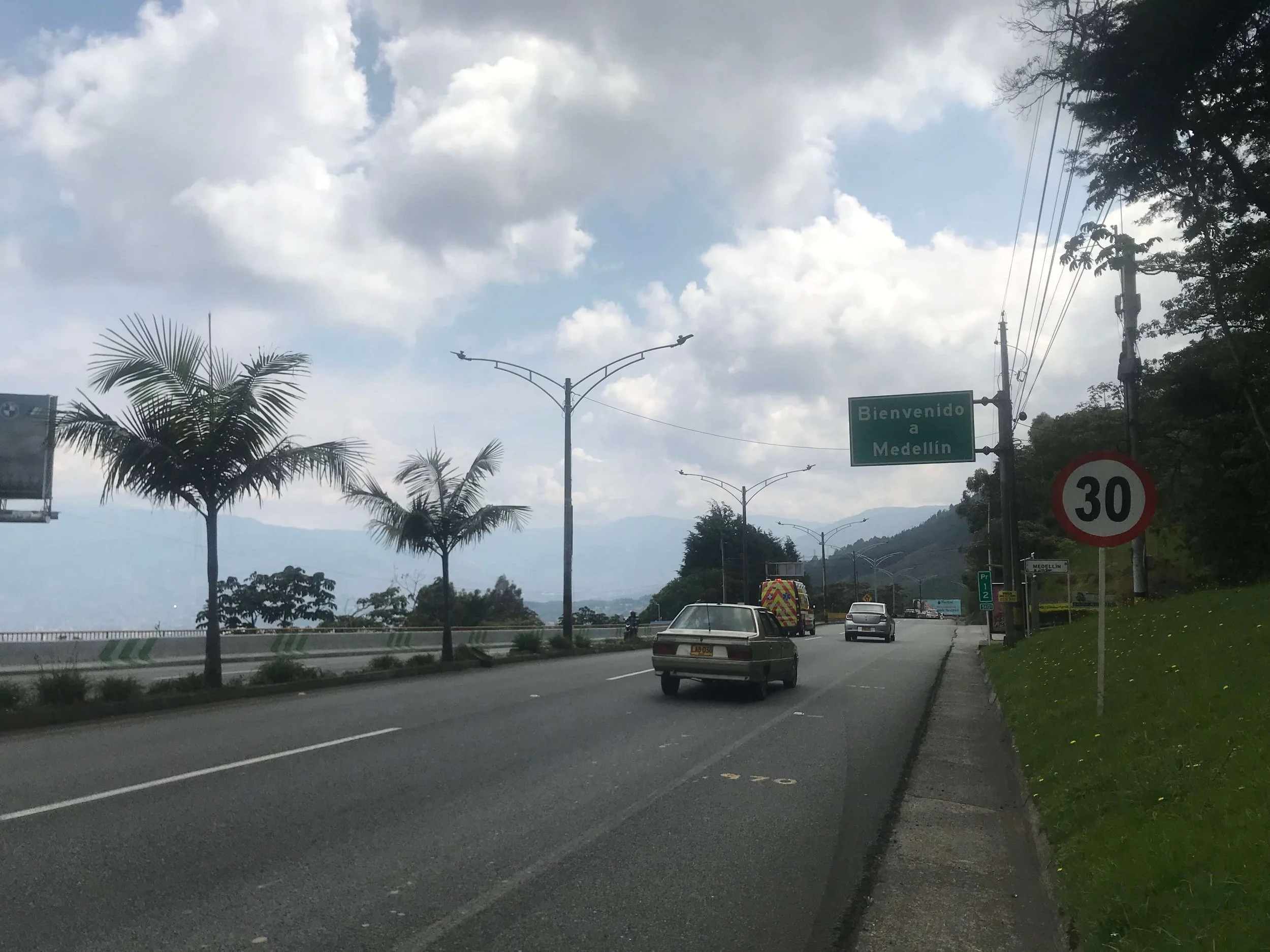
Avenida Las Palmas is only closed to vehicles until 10am during Ciclovía
I didn’t find the descent too technical; some corners, however, you will need to be more aware of. For me, the main issue was the number of manholes and buses pulling over to stop as you approach the city.
Takeaways for others to consider before cycling Palmas
Do it by yourself
As a casual and irregular cyclist like myself, don’t expect to keep up with seasoned cyclists, even if you are fit and active. You’re not going to be chatting on the climb either. Of course, if you know the speeds of other cyclists compared with your own, you can plan around them and start at different times so you can meet up and socialise at the top.
Properly try out your bike beforehand
For those like me who rented their bike for the climb, simply riding it from the shop to where you’re staying might not be enough to properly gauge the setup.
Treat the climb like a race day
Follow your race/match day routine. Allow your food to digest - there’s no easing into the climb. If you’re going to try out anything new, like gels, make sure you don’t do so for the first time on the climb!
Prepare for a cold descent
Consider bringing some kind of long-sleeved garment for the descent. After all, you’ll be starting your descent at over 8,000 ft/2,500 m.
Start the climb earlier than you might expect
First of all, there’s a very good chance the climb will take longer than you planned. Then, starting earlier means fewer people will be around. Plus, Avenida Las Palmas is only vehicle-free on a Ciclovía day until 10am. Then, there’s the…
Pay attention to the weather
It rains a lot in Medellín! That goes without saying. So, plan your ride around any forecast rain. I wouldn’t fancy descending in the rain.
Final thoughts whistle: Reflecting on cycling up Alto de Las Palmas
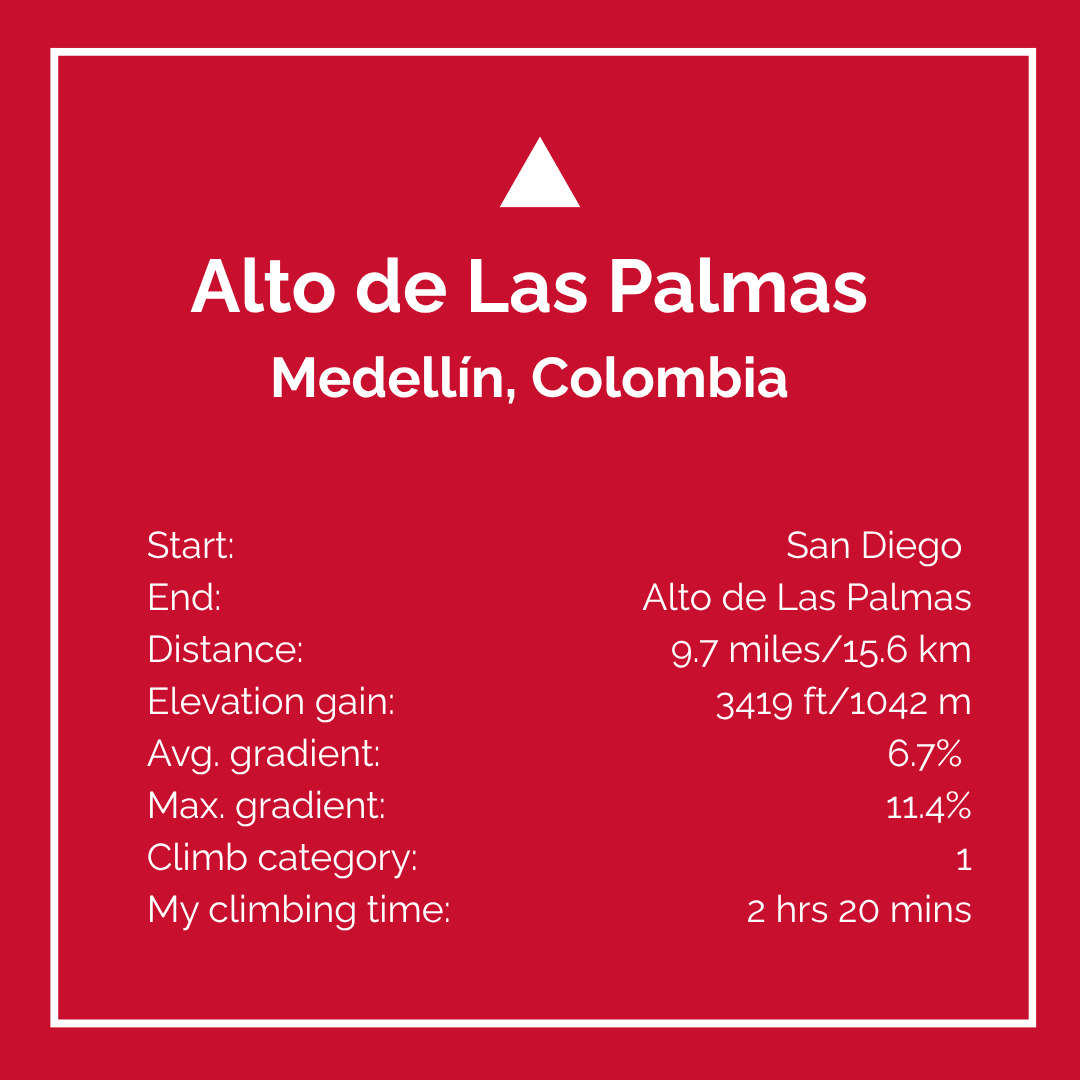
I’m not going to say I bit off more than I could chew, because I made it to the top. That said, I was doubting whether I’d make it for much of the climb. I didn’t think it would push me to want to stop as much as it did.
I’ll admit I went in a little blindly. There was a degree of naivety on my part. I was banking on my general activeness and fitness and previous cycling experience to see me through, and they did, but I wasn’t expecting to feel so broken. It was humbling. Ultimately, the climb took a lot more out of me physically than I could have imagined. I felt drained, both at the top and when I finished. It was very similar to how I felt after my one and only ultra-marathon, where I spent over eight hours on my feet. Like then, I was just flat and lethargic for the rest of the day, despite spending not much more than a quarter of the time climbing Palmas.
If I were to climb Palmas again, I’d certainly get some more miles and climbs under my belt beforehand. After all, I wouldn’t take on a marathon without any training.
Extra time: What is Sports and Suitcases?
Start playing sport in Medellín
I put Sports and Suitcases together to act as a resource for sporty people looking to play sport or exercise in Medellín. I want to show that it’s possible to play the kinds of sports you would play back home, as well as how you can make sport and exercise part of your routine to help you establish a new life in Medellín. Be sure to browse the site and find out how you can keep active in Medellín!